For Shopify & DTC sellers · One filing, all channels

German VAT for your Shopify store.
One filing, all channels.

Selling to Germany through Shopify, with or without a German 3PL? We handle the German VAT registration and filing for your Shopify sales, your Amazon sales, and everything in between. Reviewed and signed by a licensed German Steuerberater before every filing.

✓  One registration covers every channel ✓  No fiscal representative required ✓  Flat fee, no per-channel surcharge
VAT return · OctoberTest data
One return, every channelExample Trading LtdReady to file
ChannelSales, net
Shopify store€4,820.00
Amazon.de€3,145.50
eBay.de€1,260.00
Direct orders€690.00
3PL in GermanyStock in a German warehouseNeeds a German VAT number from the moment it arrives.
All channels
One filing covers them
from €99
per month, flat, no per-channel fees
4–8 wks
To your Steuernummer
Registered with the Steuerberaterkammer Rheinland-Pfalz
A product of FRADECO GmbH, licensed German tax advisory, serving international sellers since 2021
Filing VAT for sellers on

The short version

German VAT registration is triggered by three things for Shopify sellers: (1) storing inventory in Germany (3PL, Shopify Fulfilment Network, or Amazon FBA DE); (2) B2C cross-border sales without OSS; (3) digital services to German consumers without OSS.

Storing inventory in Germany is the big one: it triggers registration from the first unit, no threshold. One narrow exception since 2025: a very small company established in another EU country (turnover under €100,000 across the EU) can use the EU small-business scheme through its home tax office (§ 19 Abs. 4 UStG); it rarely fits stock held in Germany. A Shopify Fulfilment Network location in DE, a German 3PL, or Amazon FBA DE inventory all count.

One German VAT registration covers all your sales channels (Shopify, Amazon, eBay, direct orders) under a single VAT return (UStVA). Typical year-one cost via Vaytax: €1,299/year all-in, German VAT registration included, or €99/month flat if you already have a German VAT number.

Not sure if this applies to your store? Take the 60-second VAT check →

€99
Per month · existing VAT number
€1,299
Per year all-in · registration included
€300 + €200
OSS setup + per quarter · non-EU sellers
€199
EORI application · non-EU sellers
Past returns are filed at €99 per return. Tax advisory beyond routine filings is €200 per hour, quoted before any work starts.
Who this is for

Shopify stores with a German VAT obligation

The three most common profiles. If one of these sounds like you, registration is almost certainly mandatory.

Stores using a German 3PL or SFN

Shopify Fulfilment Network DE, a German third-party logistics provider, or consignment stock in a German warehouse. The moment your inventory sits on German soil, registration is mandatory, from the first unit.

Hybrid Shopify + Amazon sellers

You list the same SKUs on Shopify and Amazon, and your Amazon FBA inventory is in Germany. German inventory means German VAT registration, and one registration covers both channels.

Cross-border DTC & digital sellers

Shipping B2C into Germany from elsewhere in the EU, or selling digital services to German consumers. You either register in Germany or use OSS; local registration is often cleaner for enterprise B2B.

Decision matrix

Do you need German VAT?

Four common Shopify scenarios and what each requires.

Scenario 1 · Registration required

You store inventory in Germany

You use Shopify Fulfilment Network DE, a German 3PL (byrd, WeFulfil, independent warehouses), or you have Amazon FBA DE inventory backing some of your Shopify orders. Local German VAT registration is mandatory, from the first unit stored, with no threshold. OSS does not replace this.

Scenario 2 · Registration or OSS required

You ship from outside Germany, B2C to DE consumers

You ship from, say, the NL or PL directly to German consumers and your cross-border B2C sales exceed €10,000 a year, or you ship from the UK or US, where no threshold is available to you at all. You must either register in Germany or use OSS (Union for EU-based sellers, Non-Union for outside-EU). OSS is usually simpler if you have no German inventory.

Scenario 3 · OSS or local

You sell digital services to German consumers

SaaS subscriptions, digital downloads, online courses. You either register in Germany or use OSS (Union or Non-Union scheme depending on your base). For enterprise B2B deals, many German buyers prefer seeing a real DE-prefixed USt-IdNr., which is one reason to pick local registration over OSS.

Scenario 4 · No registration needed

EU-established seller, B2C to Germany, no German inventory, under €10k EU-wide

If your company is established in an EU country, your EU-wide cross-border B2C sales are below €10,000 per year and you have no German inventory, you can charge your home-country VAT. A company established outside the EU has no such threshold. No German registration, no OSS needed yet. Monitor the threshold monthly.

Why the German 3PL trigger catches Shopify sellers off guard

The German VAT obligation kicks in the moment goods are stored on German soil, regardless of where your company is based, where your Shopify store ships from most of the time, or how much you sell. This trips up three groups of Shopify sellers in particular:

  1. Shopify Fulfilment Network expansions. SFN has warehouse locations across Europe; adding a German SFN location for faster delivery creates a VAT obligation from day one of operation.
  2. Third-party logistics providers. German 3PLs advertise fast DE delivery to Shopify sellers, and the VAT trigger is easy to miss in the middle of a fulfilment onboarding: the moment your inventory arrives at their German warehouse, you need a German VAT number. Most providers ask for your USt-IdNr. eventually, often well after your first shipment. We work with byrd directly on German VAT guidance for their sellers.
  3. Hybrid Shopify + Amazon sellers. You list the same SKUs on Shopify and Amazon. Your Amazon FBA inventory is in Germany. Your Shopify orders may be fulfilled from that same FBA inventory (via Multi-Channel Fulfilment). Either way, German inventory means German VAT registration.

Practical check: ask your 3PL where your inventory physically sits. If any of it is in Germany, even temporarily, you need a German Tax ID. Retroactive registration after the fact is always more expensive than registration before the first shipment.

OSS vs local registration: the Shopify decision

OSS (One-Stop Shop) lets you file a single quarterly return covering B2C cross-border sales to all EU countries. It's a simplification regime: one return, one payment, one home-country tax office. Local registration means one tax office per EU country where you have obligations.

Factor OSS Local German registration
Works for inventory in Germany? No, OSS doesn't cover local inventory sales Yes, standard path
Filing frequency Quarterly Monthly or quarterly, as the tax office decides
Number of returns per year 4 (plus domestic returns) 4 or 12, plus 1 annual
Language of filing Your home country's system German (to the Finanzamt)
Complexity Lower Higher (but a tax advisor handles it)
Good for enterprise B2B signaling? No DE USt-IdNr. visible Real DE-prefixed number

The honest rule: if you have no German inventory and only cross-border B2C shipments into DE, OSS is simpler. If you have any German inventory (SFN, 3PL, FBA), you need local registration, OSS is not an option for those sales. Many sellers need both: OSS for cross-border and local DE registration for inventory-based sales. See our deeper OSS vs local VAT guide.

Does Shopify collect German VAT like Amazon does?

No. Shopify gives you the software for your own shop; it is not a marketplace, so German law never treats it as the deemed supplier (the platform taxed as if it had made the sale itself). You are the seller on every Shopify order, and once one of the triggers above applies, the registration, the returns and the payment to the Finanzamt are yours. Shopify's tax settings add VAT at checkout, but that money arrives in your account, not at the tax office.

Amazon, Etsy, eBay and TikTok Shop can work differently. On some sales (imported parcels worth up to €150, and goods already inside the EU sold by a seller established outside it) the marketplace charges and pays the German VAT itself. Stock held in Germany still needs your own German registration either way: the marketplace rule only changes who pays the VAT on the sales it covers.

How Shopify tax collection works with German VAT

Once you have your German Tax ID and USt-IdNr., setup in Shopify is straightforward:

  1. Shopify Admin → Settings → Taxes and duties.
  2. Under EU, add Germany with your German tax registration details.
  3. Shopify will then automatically apply the correct VAT rate to German customer orders: 19% standard, 7% reduced (books, certain food, select other categories).
  4. Decide whether prices show as VAT-inclusive or VAT-exclusive. In Germany B2C most stores show VAT-inclusive prices with "inkl. MwSt." disclosure.

For each filing, you export your Shopify orders (Orders → Export, the dates of the filing period, as a CSV file) and upload the file in your dashboard. We read every order, place it in the month it was delivered, and show you your German figures, with anything unusual set aside and named. You check them, and we file. How to export your Shopify orders.

Hybrid sellers: Shopify + Amazon on one VAT registration

Most serious e-commerce brands sell on multiple channels. German VAT handles this cleanly: one registration, one Tax ID, one VAT return (UStVA) covering all channels. You aggregate:

Important: where Amazon acts as the "deemed supplier" under §3 Abs. 3a UStG (mainly for non-EU sellers on certain SKUs), Amazon collects and remits the VAT itself, so those sales are excluded from your UStVA. Vaytax's dashboard separates marketplace-collected VAT from your own.

No fiscal representative, no per-channel fees

Two points on cost:

  1. Fiscal representation. Germany does not require a fiscal representative for standard VAT registration and filing; a licensed German tax advisor acting for you is enough. A separate fiscal-representation fee is not needed for standard German VAT compliance.
  2. Per-channel or per-transaction fees. Vaytax's €99/month is flat: your Shopify volume could grow 10x with no fee increase.

What this looks like for two Shopify sellers

Examples from our own clients, shared without names.

A US manufacturer of audio equipment sells through its Shopify store and keeps stock at a third-party warehouse (3PL) in Germany. That stock is the German 3PL trigger described above. Its registration goes to the tax office in Bonn (Finanzamt Bonn-Innenstadt), which handles companies from the United States, because the office follows the country the company is established in, not where the warehouse is.

A Slovenian company sells garden and outdoor goods through Shopify to consumers and businesses in Germany. It ships from its own stock in Slovenia, so nothing is stored in Germany, and it also sells into France. With no German warehouse, its question is the cross-border one from the scenarios above, not the warehouse trigger.
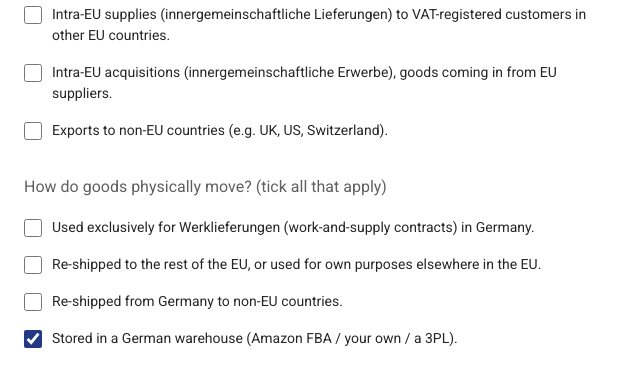
The registration form

Registration starts with where your stock sits.

vaytax.com/register · Your business
Registration form for an example company: how goods physically move, with Stored in a German warehouse (Amazon FBA, your own or a 3PL) ticked
The real dashboard, shown with an example company and test data.
  1. Register once

    One registration covers every channel: Shopify, Amazon and the rest.

    Waiting on you
  2. Your Steuernummer

    Typically 4 to 8 weeks after the registration goes to the Finanzamt.

    In progress
  3. One filing, all channels

    Reviewed and signed by a licensed German Steuerberater before every filing.

    Delivered

Already selling without a German VAT number?

Common pattern for marketplace sellers: you crossed a German storage or sales threshold months ago and only just discovered the obligation. We file the missing UStVAs retroactively at the same flat €99 per filing, charged once at signup. Pick the first period you need us to file when you register, and we'll catch you up while we handle every period going forward.

The Finanzamt may issue late-filing surcharges (Verspätungszuschlag) directly to your company for any retroactive period. Those are independent of our fees, and we file as quickly as possible to keep them small.

Your tax office
Assigned by your country of establishment, not by where your stock sits. Look up yours.
Fiscal representative
Not required. A licensed German tax advisor acting as your tax agent is sufficient.
Filing cadence
VAT return (UStVA) monthly or quarterly, as the tax office decides, each due by the 10th after the period, plus the annual return.
Cost
You pay €1,299 per year all-in with registration, or €99 per month with an existing Steuernummer.
Transparent pricing

One flat fee per plan, all channels

No per-transaction or per-channel fees. The price you see covers your routine recurring filings; one-off work like backfiling or disputes is always quoted up front.

New to German VAT · Path A

€1,299 / year, all-in

€1,299 / year

German VAT registration included. Charged in full at signup. Renews yearly.

What's included

  • German VAT registration
  • Every VAT return (UStVA), monthly or quarterly
  • Annual VAT return (Umsatzsteuer-Jahreserklärung)
  • Filed in the official Finanzamt format
  • All your channels on one filing
  • All routine tax-office correspondence
  • Licensed German tax advisor
  • Dashboard in English
Start registration

Already registered · Path B

€99 / month

Already hold a German VAT number? Skip the registration fee and move straight into filing. €1,099/year if you pay annually.

€99 / month

Or €1,099 billed yearly. No registration fee.

  • Every VAT return (UStVA), monthly or quarterly
  • Annual VAT return included
  • Shopify, Amazon, eBay, direct, all on one filing
  • All routine tax-office correspondence
Covers your routine recurring filings. Backfiling past periods, corrections, and one-off Finanzamt disputes are quoted separately, never silently billed. OSS is an optional add-on (€300 one-time + €200/quarter).
See filing plans
Urgent · Finanzamt letter

Got a letter from the Finanzamt? Read it free. Then have it handled.

Free instant English read, no signup. Then a fixed price from €200 net, nothing to pay until you accept. Estimated assessment (Schätzbescheid), payment reminder (Mahnung), formal hearing notice (Anhörung).

Read my letter
Already have a German VAT problem?
Case work, quoted before it starts: outstanding years, a switched-off number, a letter with a deadline, an address change.
See the cases →
Questions

Shopify sellers ask us this

Does my Shopify store need a German VAT number?

It depends on three triggers: (1) if you store inventory in Germany (via a German 3PL, Shopify Fulfilment Network location, or Amazon FBA inventory backing your Shopify), you MUST register for German VAT from day one, no threshold applies. (2) If you ship B2C goods from elsewhere in the EU into Germany you must either register in Germany or use OSS; the €10,000 EU-wide threshold that delays this is only available to sellers established inside the EU. (3) If you sell digital services to German consumers, you must either register in Germany or use OSS (Union or Non-Union scheme depending on your base).

OSS or local German VAT registration, which should a Shopify store use?

If you ship from your home country (say, the Netherlands or the UK) directly to German consumers with no German inventory, OSS is typically simpler, one quarterly return covers all EU countries. If you store inventory in Germany (Shopify Fulfilment Network DE, any German 3PL, or Amazon FBA DE), you MUST have a local German registration in addition to any OSS. OSS does not cover sales from EU-stored inventory. Many Shopify-plus-Amazon hybrid sellers need both.

Does using a German 3PL trigger VAT registration?

Yes, immediately and without threshold. The moment goods are stored on German soil (whether at a Shopify Fulfilment Network location, byrd, WeFulfil, or any independent 3PL), you have a taxable presence and must register before you start fulfilling orders from that inventory. Many Shopify sellers discover this only after their 3PL asks for a German USt-IdNr., by which point they're already operating non-compliantly.

Do Shopify sellers need a fiscal representative in Germany?

No. Germany does not require a fiscal representative for standard VAT registration and filing; a licensed German tax advisor acting for you is enough. This applies to EU and non-EU companies alike. A separate fiscal-representation fee is not needed for standard German VAT compliance.

How do I collect German VAT on my Shopify store?

Shopify's tax settings support German VAT. Once registered, enter your German tax registration into Shopify Admin → Settings → Taxes and duties → Germany. Shopify will then apply 19% (standard) or 7% (reduced, for books, food, certain other categories) VAT to German customer orders and show prices inclusive or exclusive per your setup. The VAT collected is what you then remit through your VAT return (UStVA).

How does Vaytax handle Shopify data for filing?

You export your Shopify orders (Orders → Export, the dates of the whole filing period, as a CSV file) and upload the file in your dashboard. We read each order: German sales at 19% and 7% go on the return, sales to consumers elsewhere in the EU with their VAT charged are shown per country for the One-Stop-Shop (OSS), exports are flagged for proof of export, and anything unclear is set aside and named. You check the figures, and we file the UStVA with the Finanzamt. If you also sell on Amazon, upload its VAT Transactions Report for the same period: every channel goes on one return. Step-by-step export guide.

What if I sell on both Shopify and Amazon to German customers?

You report the combined German sales on one UStVA filed against your single German Tax ID. One registration covers all sales channels into Germany. You aggregate Shopify sales, Amazon sales, eBay sales, etc. into the VAT return. Amazon's §25e marketplace liability rules may mean Amazon already collects and remits VAT for certain transactions, in which case those sales are excluded from your Voranmeldung. The Vaytax dashboard handles the distinction.

What does Vaytax charge Shopify sellers for German VAT compliance?

€1,299/year all-in if you need German VAT registration, which is included (every VAT return (UStVA), annual VAT return Umsatzsteuer-Jahreserklärung, filing with the Finanzamt, every tax-office letter read and explained with the deadline named). That is the Standard plan; Pro adds the source check and tax advisor hours. Already have a German VAT number? Filing-only is €99/month, or €1,099/year. No per-transaction fees, no per-channel surcharges, your Shopify, Amazon, and eBay sales all file together under one flat fee per plan.

Question we didn't cover? Send us a message →

Free PDF · Every country
The exact documents you need, by country
A per-country checklist of what the Finanzamt needs to register you for German VAT. Printable, free.
Get the checklist →

Not sure what you need?

Find out exactly what applies to your Shopify store first.

Answer a few quick questions about how and where you sell. We will tell you whether Germany requires you to register, and what it costs, in plain English. No account, no obligation.

Free. Takes about a minute. We never share your email.

Scale your Shopify store into Germany.

German VAT registration plus filing across all your channels, handled end to end by a licensed German tax advisor. Built for DTC brands. Reviewed June 2026 by a licensed German tax advisor.

Start registration